 Carroll “Frank” Clay
If you've started shopping for life insurance, you've probably run into three names over and over: term, whole life, and IUL (indexed universal life). Each one pays your family a tax-free death benefit if you pass away. Where they differ is how long the coverage lasts, what it costs, and whether it builds cash value you can use while you're alive.
Here's the plain-language version, without the sales pitch.
The Short Answer
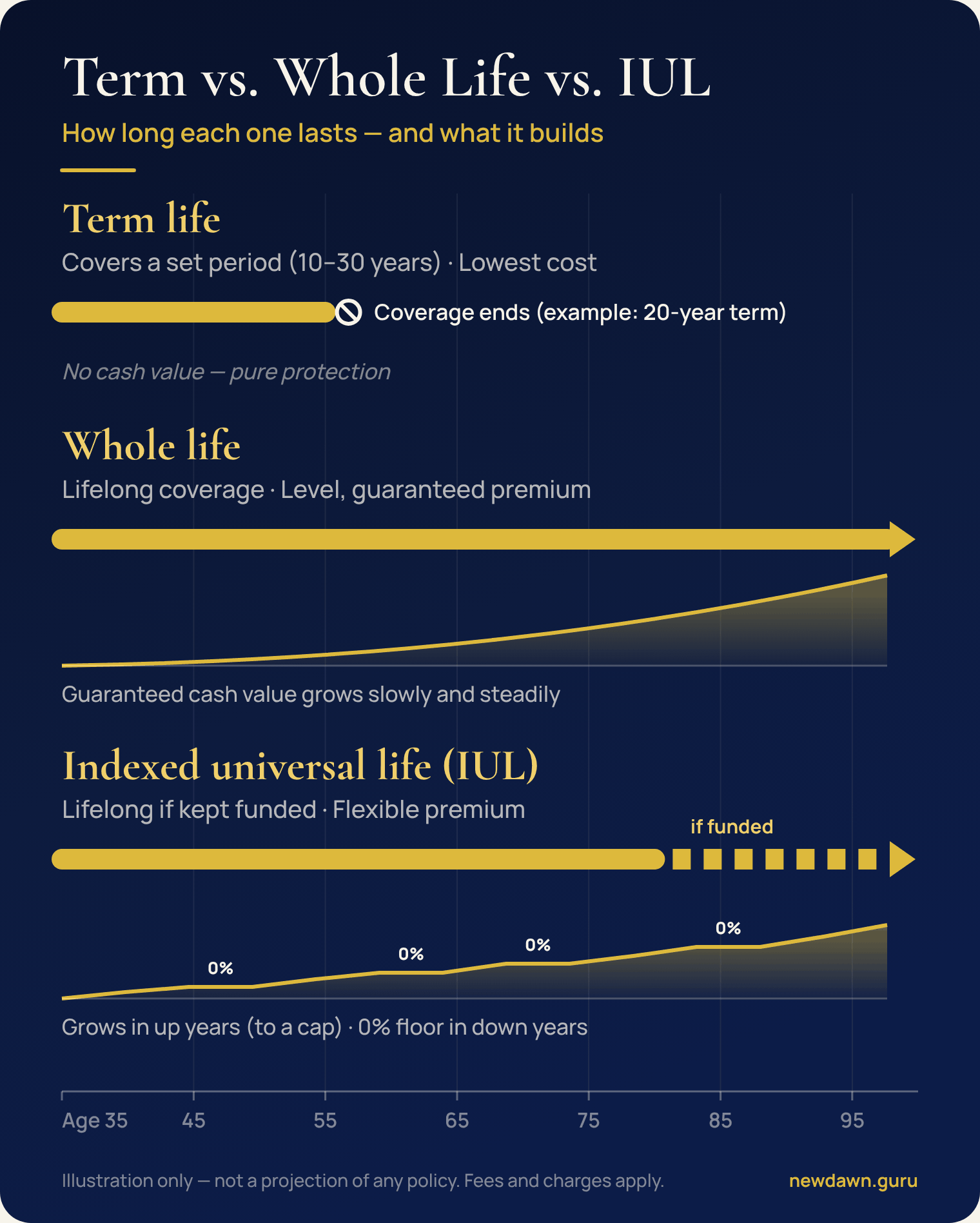
- Term life is the most coverage for the lowest cost, for a set number of years. It fits a need that ends — raising kids, paying off a mortgage, replacing your income until retirement.
- Whole life lasts your entire life with a premium that never goes up and cash value that grows on a guaranteed schedule. It fits a need that never ends — and costs much more.
- IUL also lasts for life, but with flexible premiums and cash value that grows based on a stock market index, within limits. It offers more upside than whole life, with fewer guarantees and more moving parts.
Term Life: Coverage for the Years You Need It Most
Think of term life like renting protection. You pick a length — usually 10, 15, 20, or 30 years — and a coverage amount. Your premium stays level for that whole term. If you pass away during the term, your beneficiaries receive the death benefit. If you outlive it, the coverage ends and you've paid for peace of mind, not savings.
Because there's no savings piece, term is by far the least expensive way to buy a large amount of coverage. That's why it's usually the first tool for income replacement: making sure your family can keep the house, pay the bills, and cover college if your paycheck stops.
Good to Know
Many term policies include a conversion option: the right to switch some or all of the coverage to a permanent policy later, without a new medical exam. If your health changes, that option can be worth a lot. Ask about it before you buy.
Whole Life: Permanent Coverage With Guarantees
Whole life is more like owning with a fixed-rate mortgage. The coverage lasts your entire life as long as you pay the premium, and that premium is locked in and never increases.
Part of each payment builds cash value that grows on a guaranteed schedule, tax-deferred. Some policies from mutual companies may also pay dividends, though dividends aren't guaranteed. You can borrow against the cash value or surrender the policy for it later. Growth is slow in the early years, then picks up over time.
The trade-off is cost. For the same death benefit, whole life commonly costs many times more than term. That's fine when the need is truly permanent — it's a problem when it means buying far less coverage than your family actually needs.
IUL: Permanent Coverage With Flexibility (and More Moving Parts)
Indexed universal life is also permanent coverage, but it's built differently. Your premiums go into the policy, the insurer takes out the cost of insurance and fees each month, and whatever is left is your cash value. That cash value earns interest based on how a market index, such as the S&P 500, performs — within limits:
- The floor (often 0%): in a year the index goes down, you're credited 0% instead of losing money to the market drop.
- The cap: in a year the index goes up, your credit is limited. For example, with a 9% cap, a 15% index gain is credited as 9%.
- The participation rate: some policies credit only a percentage of the index's gain.
Your money is not invested in the stock market. IUL is life insurance, and the index is only used to calculate interest. Premiums are flexible: within limits, you can pay more in good years and less in tight ones.
Read This Before You Buy an IUL
- Funding matters. The cost of insurance rises as you age. If a policy is paid too little for too long, the cash value can run down and the policy can lapse, sometimes late in life when it's hardest to replace.
- Illustrations aren't promises. The sales illustration shows what could happen at assumed rates. Caps, rates, and charges can change. Ask to see the guaranteed column and a lower-return scenario, too.
- A 0% floor doesn't mean the cash value can't drop. Monthly charges still come out in years when the credit is 0%.
- It's a long-term commitment. Surrender charges often apply in the first 10 to 15 years.
Side by Side
| Term | Whole life | IUL | |
|---|---|---|---|
| How long it lasts | A set period (10–30 years) | Your whole life | Your whole life, if kept funded |
| Cost for the same coverage | Lowest | Highest | In between; depends on how you fund it |
| Premium | Level for the term | Fixed and guaranteed | Flexible, within limits |
| Cash value | None | Guaranteed growth, plus possible dividends | Interest tied to an index, with a cap and floor |
| Guarantees | Death benefit during the term | Strongest | Fewer; depends on funding and current rates |
| Complexity | Simple | Moderate | Highest |
| Often a fit for | Families, homeowners, income replacement | Lifelong needs, final expenses, estate and legacy planning | Lifelong coverage plus long-term cash value, for people who can fund it steadily |
Which One Fits You?
A few quick questions usually point in the right direction:
- Is your need temporary? If you mainly want to protect your family until the kids are grown or the mortgage is paid, term usually does the job for the least money.
- Do you want coverage that's guaranteed to last for life, with a premium that never changes? Look at whole life — or a guaranteed universal life policy, which focuses on the lifelong death benefit with less cash value.
- Have you already covered the basics (emergency savings, retirement contributions, enough term coverage) and want permanent coverage that can also build cash value over decades? IUL may be worth a careful look.
- Is your budget tight? Buy the coverage your family actually needs first. Enough term coverage beats too little permanent coverage.
You don't have to choose just one, either. Many families pair term for the big, temporary need with a smaller permanent policy for final expenses or a legacy.
"The right life insurance isn't the fanciest product — it's the one you can keep paying for that covers what your family actually needs."
Common Mistakes to Avoid
- Buying too little coverage because a permanent policy ate up the budget
- Treating an IUL illustration as a guarantee instead of one possible outcome
- Underfunding a flexible policy and finding out years later it's at risk of lapsing
- Letting a term policy expire without checking its conversion option first
- Replacing an existing policy without comparing what you'd give up — new surrender charges, new medical underwriting, a new contestability period
The Bottom Line
Term, whole life, and IUL are different tools for different jobs. Term protects your family during your highest-obligation years at the lowest cost. Whole life gives you lifelong coverage with the strongest guarantees. IUL offers lifelong coverage with flexibility and index-linked growth — as long as it's set up and funded properly.
As an independent agent, I'm not tied to one company or one product. I'll walk you through what each option would look like for your age, health, and budget, side by side, so you can decide with confidence. For more on the first two, see Term vs. Whole Life: Which One Actually Makes Sense for You?
Ready to compare your options? Book a free call on my calendar, or request a quote below.